Your scalp is a self-regulating system. It manages oil production, maintains a microbial barrier, drains lymphatic fluid, and supplies every follicle through a dense microvascular network. When any part of that system drifts out of balance, the downstream effects compound. Excess oil feeds certain fungi. Inflammation thickens the tissue around follicles. Sluggish circulation starves them of oxygen.
Regular head spa sessions prevent that cascade. By clearing congestion, restoring circulation, and supporting the microbiome on a consistent schedule, the scalp stays in a state where it can self-regulate effectively. Think of it the same way you think about dental cleanings. You brush every day, but professional cleaning catches what daily maintenance misses before it becomes a problem.
What does a head spa actually do?
A head spa works on multiple scalp systems in a single session. That is what separates it from a salon shampoo upgrade or a scalp massage at a day spa. A clinical session targets four things at once.
First, it clears the follicular environment. Oil, dead skin, mineral deposits from hard water, and product residue accumulate around the follicle opening over time. That buildup is occlusive. It physically restricts the follicle and creates an environment where inflammation takes hold. Exfoliation and clinical-grade cleansing remove that barrier so the follicle can function normally.
Second, it restores circulation. Scalp tissue is among the most metabolically active skin on your body. Hair follicles demand constant oxygen and nutrient delivery through microvascular blood supply. Therapeutic massage and stimulation techniques increase blood flow to the scalp, which is why circulation-related benefits (thicker-feeling strands, reduced shedding) show up consistently with regular sessions.
Third, it addresses the scalp's microbiome. Like your gut, your scalp maintains a community of microorganisms that keep the skin barrier healthy. When that balance shifts, you get inflammation, flaking, irritation, and an environment hostile to hair growth. Targeted treatments restore balance without stripping the scalp the way harsh shampoos can.
Fourth, it provides nourishment that home products cannot deliver at the same concentration. Professional-grade serums, hydration masks, and repair treatments penetrate more effectively on a properly exfoliated, circulation-primed scalp than they would on top of a week's worth of buildup.
At
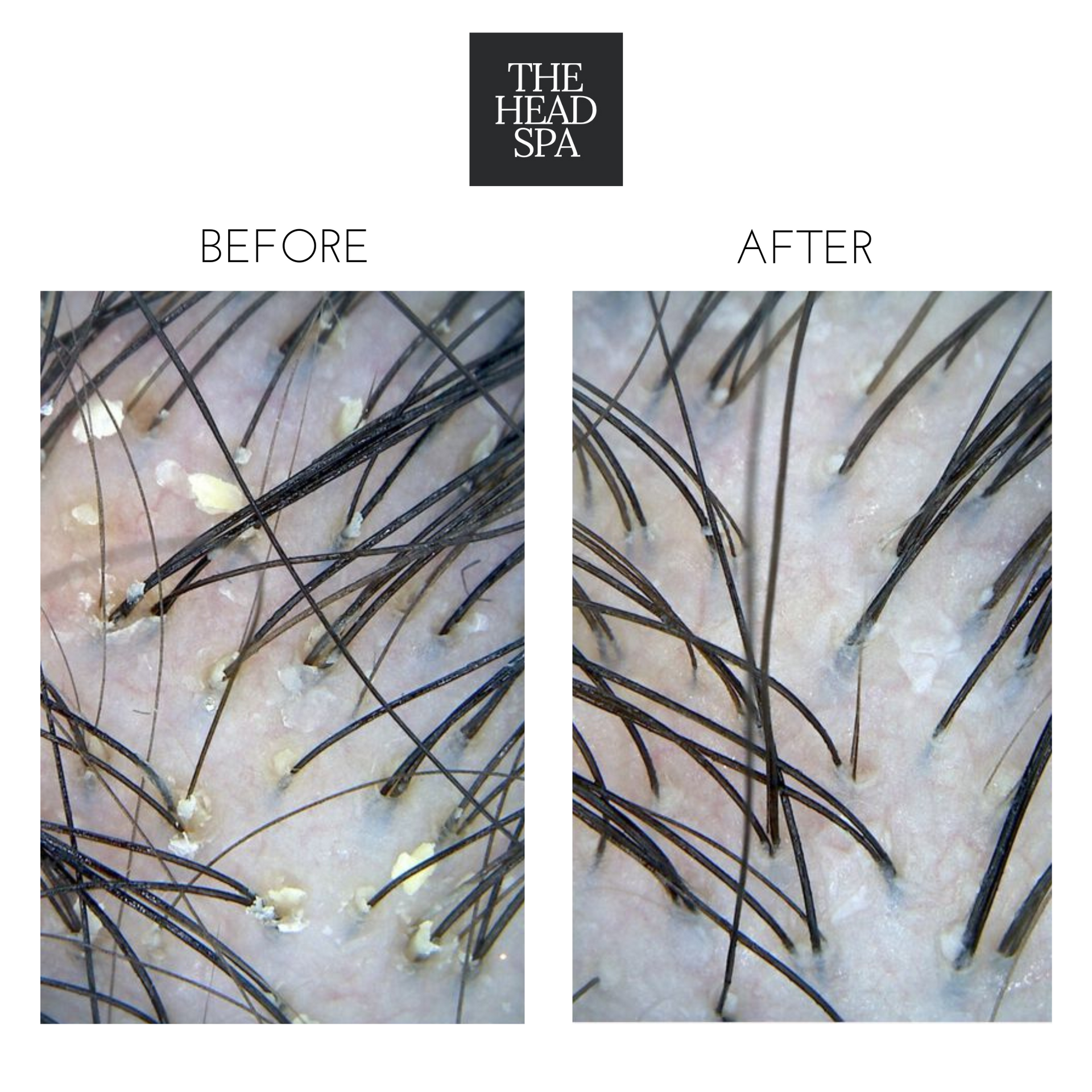
The Head Spa, every session begins with a Microscopic Scalp-Skin Screen that identifies which of these systems needs the most attention. The treatment plan builds from that diagnostic, not from a preset menu. That is the clinical difference. You can read the full treatment walkthrough in our guide to
what a head spa is.
9 benefits of regular head spa treatments
After 20 years in clinical medicine, Sophia does not talk about hair in vague terms. These are the outcomes her clients report consistently across regular sessions. Each one ties back to a specific mechanism in the scalp environment, and each one shows up under the microscope visit after visit.
Maintaining a healthy scalp ecosystem
Your scalp is a self-regulating system. It manages oil production, maintains a microbial barrier, drains lymphatic fluid, and supplies every follicle through a dense microvascular network. When any part of that system drifts out of balance, the downstream effects compound. Excess oil feeds certain fungi. Inflammation thickens the tissue around follicles. Sluggish circulation starves them of oxygen.
Regular head spa sessions prevent that cascade. By clearing congestion, restoring circulation, and supporting the microbiome on a consistent schedule, the scalp stays in a state where it can self-regulate effectively. Think of it the same way you think about dental cleanings. You brush every day, but professional cleaning catches what daily maintenance misses before it becomes a problem.
Reduced shedding and fallout
Shedding accelerates when follicles are stressed. Inflammation, restricted blood flow, and occlusive buildup all signal the follicle to shorten its growth phase and release the strand earlier than it should. This is not pattern hair loss. It is environment-driven shedding, and it responds to environment-level intervention.
A clinical head spa addresses the triggers directly. Exfoliation clears the physical obstruction. Massage and stimulation restore the blood flow that delivers oxygen and nutrients. Anti-inflammatory treatments calm the signaling that pushes follicles into early release. Clients dealing with stress-related or seasonal shedding tend to see measurable reduction within three to four sessions.
Reduced dandruff and buildup
Dandruff is an inflammatory response, not a hygiene problem. Most cases involve Malassezia, a yeast that feeds on scalp oils and triggers the flaking cycle. Over-the-counter dandruff shampoos suppress symptoms but do not address the underlying microbiome imbalance or the buildup layer that creates a hospitable environment for overgrowth.
A head spa tackles the root causes. Deep exfoliation removes the flake and sebum layer where Malassezia thrives. Targeted treatments rebalance the scalp's microbial community. Hydration repairs the skin barrier that keeps the cycle from restarting. For persistent dandruff, regular sessions paired with a customized home regimen produce results that medicated shampoos alone typically cannot match.
Improved hair density
Most people think of density as a fixed genetic trait. It is not. Density reflects how many follicles are actively producing strands at any given time. When follicles are blocked, inflamed, or starved of nutrients, some go dormant. They are still there. They just stop producing. Under magnification, this shows up as follicular miniaturization, and it is one of the first things a Microscopic Scalp-Skin Screen catches.
Clinical scalp care reactivates the environment around those dormant follicles. Removing occlusive buildup, reducing inflammation, and improving the oxygen supply to the dermal papilla (the blood-supply structure at the base of the follicle) gives dormant follicles a reason to re-enter the growth phase. This is a gradual process. Most clients notice density improvements over eight to twelve weeks of consistent treatment.
Increased strand production
This is different from density, though they are related. Strand production refers to how quickly and robustly individual follicles generate new hair. A follicle with adequate blood supply and low surrounding inflammation produces stronger, faster-growing strands than one struggling in a congested environment.
The circulation boost from scalp massage and LED stimulation (available in
Emerald and Diamond tier sessions) directly supports the anagen (growth) phase of the hair cycle. Better blood flow means more oxygen and nutrients reach the dermal papilla during the phase when the strand is actively being built. Clients on a regular schedule commonly report faster regrowth and less breakage at the root.
Reduced scalp irritation
Itching, burning, and tenderness are all inflammation signals. They mean the scalp barrier is compromised and the immune response is active. Scratching makes it worse by creating micro-tears that invite further irritation and potential infection.
A clinical session addresses irritation at the source. Anti-inflammatory treatments calm the immune response. Barrier-repair formulations restore the protective lipid layer. Hydration reduces the tightness and dryness that trigger the itch cycle. Sophia's approach at The Head Spa is to identify the cause of the irritation under magnification first, because treating symptoms without understanding the trigger is how clients end up stuck in a cycle of temporary relief and recurrence.
Improved strand strength and shine
You cannot change your hair's inherent texture. That part is genetic. But the condition of the scalp producing those strands and the care those strands receive after they emerge? That is entirely within your control. A strand that grows from a well-nourished, non-inflamed follicle is structurally stronger than one that grew from a compromised environment. You can feel the difference.
Head spa treatments improve strand quality from both directions. Scalp-level care ensures the strand starts healthy. Strand-level treatments like the KERASTASE FUSIO REPAIR (included in all tiers at
The Head Spa) address damage, porosity, and moisture loss in the existing hair. The result is a visible difference in shine, elasticity, and resistance to breakage.
Stronger strand resilience
Every day your hair takes a beating: heat styling, sun exposure, the mechanical friction of brushing and tying it back. How well it holds up depends on whether the cuticle layer is intact and the internal moisture balance is right. Porous, dry strands snap. Healthy ones bend.
Regular professional repair treatments rebuild the cuticle structure and restore the lipid balance that keeps strands flexible rather than brittle. When paired with a tailored home regimen (which every session at The Head Spa includes), the compounding effect over time is significant. Clients who used to lose length to breakage faster than they gained it start retaining length because the strands themselves are more durable.
Better results from home hair regimens
This is the one most people do not expect. Your daily produc ts perform dramatically better on a clean, exfoliated, properly balanced scalp than on a congested one. Serums, leave-in treatments, and scalp tonics cannot penetrate effectively through a layer of sebum, mineral deposits, and dead skin.
A head spa resets the surface. After a clinical session, every product in your home routine has better access to the scalp and strand. This is why Sophia sends every client home with a written regimen prescription. The in-office treatment creates the conditions. The home regimen maintains them between visits. Skip the in-office work and your products sit on top of buildup. Skip the home regimen and the reset fades before your next appointment.
Benefits beyond your scalp
The clinical benefits drive the results. But the experience itself produces real physiological effects that extend beyond scalp health.
The therapeutic massage component of a head spa session is not decoration. Sustained scalp, neck, and shoulder massage activates the parasympathetic nervous system. Your heart rate slows, muscle tension releases, and cortisol drops measurably. Clients on a regular schedule at The Head Spa consistently report sleeping better and experiencing fewer tension headaches. That stress reduction feeds back into scalp health, too, because chronic cortisol elevation triggers telogen effluvium (stress-related shedding).
Higher-tier sessions at The Head Spa include facial restoration elements: medical-grade cleansing, hydration treatments, LED stimulation, and cryo globe therapy. Between the scalp work and the facial work, clients leave with visible improvements in skin tone and texture alongside the scalp and hair benefits. It is a full treatment from the shoulders up.
The relaxation is real. Most clients fall asleep mid-session. Sophia considers that a good sign.
Is a head spa worth it?
If the question is whether a single session will transform your hair, the honest answer is no. One visit gives you a clear diagnostic picture, a noticeably better-feeling scalp, and a reset that you will feel for a week or two. But one session does not reverse months or years of scalp neglect, just like one dental cleaning does not fix years of skipped appointments.
The value shows up with consistency. Clients who commit to a regular schedule (every four to six weeks for most people) see cumulative improvements that build on each other. Shedding slows down. Density fills in. Strands hold up better between visits. The microscopic imaging at each session documents those changes, so the progress is not subjective. You can see it on the screen.
From a cost perspective,
sessions at The Head Spa
range from $79 for a 20-minute targeted reset to $289 for a full two-hour clinical protocol with facial, massage, LED stimulation, and blowout.
Membership plans
reduce per-visit costs and include monthly add-on credits for clients on a maintenance schedule. For the level of diagnostic care and professional-grade treatment involved, clinical head spa pricing is comparable to what you would pay for a quality facial, except you are treating the skin that grows your hair.
The better question might be: what is the cost of not maintaining your scalp? By the time thinning or chronic shedding becomes visible, the underlying environment has been declining for months. Preventive care is almost always less expensive than corrective care.
FREQUENTLY ASKED QUESTIONS
How long do head spa benefits last?
A single session produces immediate results you can feel for one to two weeks. Reduced oiliness, less irritation, and noticeably softer hair are common after just one visit. The longer-term benefits, such as density improvement, reduced shedding, and stronger strands, build cumulatively over a series of sessions. Most clients settle into a maintenance schedule of every four to eight weeks to sustain results.
Can I get a head spa if I have extensions or a weave?
Yes, with some modifications. A skilled therapist can work around extensions and focus on the exposed scalp areas. In fact, clients with extensions benefit significantly from professional scalp care because extensions can trap oil and buildup underneath, creating the exact congested environment that leads to inflammation and follicular stress.
How is a head spa different from a scalp detox?
A scalp detox is one step in a head spa, not a substitute for one. Detox products remove surface buildup, which is useful. A clinical head spa includes the detox step but also adds diagnostic imaging, targeted treatments for specific conditions, therapeutic massage, professional-grade nourishment, and a home care plan. The difference is the same as the difference between washing your face and getting a clinical facial.
Do I need to wash my hair before a head spa?
No. Come with your hair in its natural, unwashed state. Your therapist needs to see your scalp's baseline oil production, buildup patterns, and product residue under the microscope. A freshly washed scalp hides the information the diagnostic screen is designed to capture.
Will a head spa help with postpartum hair loss?
Postpartum shedding is hormonally driven as estrogen levels normalize after pregnancy. A head spa cannot change your hormones. What it can do is optimize the scalp environment during a period when follicles are under stress: reducing inflammation, clearing buildup, and supporting circulation so that follicles recovering from the hormonal shift have the best conditions to re-enter the growth phase. Most postpartum clients already know the shedding is temporary. What they want is something concrete to do about it while they wait. Regular sessions give them that.